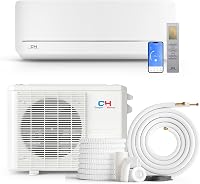
What Size Mini Split for 250 Sq Ft?
For a 250 sq ft room, choose a 9,000 BTU mini split if the space is well insulated and shaded, or a 12,000 BTU unit if it gets direct sun, has tall ceilings or sits above a garage. The 9,000 BTU size covers up to 400 sq ft in the Senville LETO line, so it leaves headroom for normal conditions.
On this page (9 sections)
- How many BTU does a 250 sq ft room need?
- Why 9,000 to 12,000 BTU is the practical range for 250 sq ft
- Which room conditions push you to 12,000 BTU?
- What about a DIY install in a 250 sq ft room?
- How do ceilings, sun and insulation change the answer?
- How do you measure the room and the install spot?
- Which mini split fits a 250 sq ft room best?
- What electrical and installation limits should you plan for?
- What size mini split for 250 sq ft should you buy?
A 250 sq ft room needs 9,000 to 12,000 BTU in most homes. Pick 9,000 BTU for an insulated, shaded room and 12,000 BTU when the space gets direct sun, has tall ceilings or sits over a garage.
That is the short answer to what size mini split for 250 sq ft comes down to, and the rest of this guide shows how to land on the right number.
Two 250 sq ft rooms can need different capacities when one faces west and the other sits in shade. The sections below walk through the math, the conditions that push you up a size, and the units that fit each case.
How many BTU does a 250 sq ft room need?
Start with about 20 BTU per square foot, which puts a 250 sq ft room at 5,000 BTU before adjustments. That base number is far below what most mini splits in this class deliver, because real rooms add heat load from sun, people and appliances.
The 20 BTU rule is a rough field estimate. Contractors use a load calculation called Manual J that weighs wall insulation, window area, climate and occupancy.
You can do a simpler version at home by starting with floor area and adding for the factors that follow.
Here is how the base figure moves for a typical 250 sq ft room:
| Condition | Adjustment | Result |
|---|---|---|
| Base 250 sq ft at 20 BTU/sq ft | None | 5,000 BTU |
| Add sun and normal insulation | Common allowance | About 7,000 to 9,000 BTU |
| Add tall ceiling or poor insulation | Higher allowance | About 10,000 to 12,000 BTU |
| Add kitchen heat or several occupants | Higher allowance | 12,000 BTU or more |
Nearly every 250 sq ft room in a normal house ends up in the 9,000 to 12,000 BTU band once you account for the real conditions. Treat the base figure as a floor, not a target.
A 5,000 BTU unit would leave almost no margin in a room that gets any sun.
Why 9,000 to 12,000 BTU is the practical range for 250 sq ft
9,000 BTU covers a 250 sq ft room in normal conditions, and 12,000 BTU covers it when the load is heavier. The gap between them is about how much extra heat the room gains beyond its floor area.
Senville rates its LETO 9000 BTU model for rooms up to 400 sq ft. A 250 sq ft room therefore sits comfortably inside its range, with headroom for a hot day or an open doorway.
That headroom is why the smaller size is the safer default for most buyers.
The 12,000 BTU class handles 250 sq ft with more reserve. Mountman rates its 12,000 BTU unit for up to 750 sq ft, so a 250 sq ft room leaves a wide margin and the unit reaches the set temperature faster.
An oversized unit is not free, though. It costs more to buy, draws more power at full output and can short-cycle in a small room.
Short cycling means the compressor starts and stops often, which reduces dehumidification and adds wear.
Pick 9,000 BTU unless the room gives you a clear reason to move up. That keeps the capacity close to the load and lets the inverter modulate instead of cycling.
When to choose 9,000 BTU for 250 sq ft
Choose 9,000 BTU when the room is insulated, shaded for part of the day and under a standard 8 ft ceiling. A bedroom, home office or small living area in a modern house usually fits this profile.
The Senville LETO 9000 BTU is built for this job. It is a 0.75 ton system with 21.5 SEER efficiency, a heat pump that works down to 5F, and a DC inverter compressor that varies output instead of switching on and off.
Its 21.5 SEER rating is the highest of the three units here, which matters if the room runs most of the day. The kit includes the indoor air handler, outdoor condenser, remote and a 16 ft line set with communication wire.
Senville pre-charges the system with refrigerant for runs up to 25 ft and backs it with 5 years on parts and 5 on the compressor.
Pick the 9,000 BTU size for a shaded, well-insulated 250 sq ft room where you want the lowest running cost. If your room fails the conditions in the next section, size up instead.
Which room conditions push you to 12,000 BTU?
Move up to 12,000 BTU when the room gains more heat than a shaded, insulated space. Sun, ceiling height, insulation quality and what sits below or above the room all change the load.
| Condition | What it does | Sizing move |
|---|---|---|
| West or south-facing windows | Adds afternoon solar heat | Go to 12,000 BTU |
| Ceiling above 9 ft | More air volume to cool | Go to 12,000 BTU |
| Room over a garage or unconditioned space | Warmer floor and walls | Go to 12,000 BTU |
| Poor insulation or older windows | Faster heat gain | Go to 12,000 BTU |
| Kitchen inside the room | Cooking adds heat and moisture | Go to 12,000 BTU |
| Basement or shaded north room | Cooler starting conditions | 9,000 BTU is fine |
A west-facing window is the single most common reason to size up. The afternoon sun can add more heat to a 250 sq ft room than the floor area suggests.
Ceiling height matters because mini splits are rated by floor area but cool the air volume, so a 12 ft ceiling means 50 percent more air than an 8 ft ceiling.
Rooms over a garage, an attic or a hot utility space start warmer than the rest of the house. The floor and walls pull heat into the room even before the sun hits.
Size up here, or the unit will struggle to hold the set temperature on hot afternoons.
Use the table as a checklist and count the conditions that apply. One or two is enough to justify 12,000 BTU.
A room that hits three or more may need 12,000 BTU or even the next size up.
When to choose 12,000 BTU for 250 sq ft
Choose 12,000 BTU when the room faces west, has tall ceilings or sits over a hot space. The Mountman 12000 BTU and the MRCOOL DIY Select 12000 BTU both land in this class, and each suits a different buyer.
The Mountman 12000 BTU runs on 110/120V power and cools up to 750 sq ft, so a 250 sq ft room gives it a wide margin. It is rated 19 SEER2 and uses R32 refrigerant.
Mountman lists four modes (cool, heat, dry, fan), four fan speeds plus auto, a sleep mode at 26 dB and an ECO mode the brand says saves up to 30 percent energy.
Its self-clean cycle dries the indoor unit after use, and an automatic defrost keeps heating steady in cold weather. The washable anti-dust filter needs a monthly rinse.
Mountman pre-charges the condenser with R32 refrigerant and includes an installation kit. The unit is a standard split system, so check the manual for the installation requirements before you buy.
Pick the Mountman when you want a conventional 12,000 BTU system installed by a technician. It has the widest stated coverage of the three units here, which gives the most margin for a sunny 250 sq ft room.
What about a DIY install in a 250 sq ft room?
A DIY mini split makes sense in a 250 sq ft room if you are comfortable mounting the indoor unit and running the line set. The MRCOOL DIY Select 12000 BTU is built for this, with a pre-charged Quick Connect line set that skips the vacuum pump, gauges and brazing.
The unit heats and cools rooms up to 550 sq ft on 115V power, so a 250 sq ft space sits well within its range. It delivers up to 17.5 SEER2 cooling efficiency and up to 9.0 HSPF2 heating efficiency.
In silent mode it runs as low as 17.5 dB(A).
The MRCOOL Comfort App and voice assistants handle settings, and the system uses R-454B refrigerant. The single-zone design suits one room, which matches a 250 sq ft space.
The DIY format means you can do the install without hiring a technician for the refrigerant work.
The catch is that DIY does not mean zero work. You still need to mount the indoor unit on a wall or bracket, drill the wall penetration for the line set, connect the Quick Connect fittings and handle the electrical hookup safely.
If the electrical panel work is beyond you, hire an electrician for that part.
Pick the MRCOOL DIY Select if you want to install the system yourself and skip the refrigerant technician. For a 250 sq ft room it delivers 12,000 BTU with a stated 17.5 dB(A) silent mode.
How do ceilings, sun and insulation change the answer?
The same 250 sq ft room can need 9,000 or 12,000 BTU depending on how much heat it gains and holds. Sun exposure is the biggest swing.
A west or south window gets direct solar heat in the afternoon, when the outdoor temperature is also highest.
Shade from trees, an awning or a covered porch cuts that load and keeps you in the 9,000 BTU range.
Ceiling height changes the volume of air the unit must cool. A vaulted or 12 ft ceiling adds 50 percent more air to condition in a 250 sq ft room.
Insulation quality sets how fast the room loses cool air and gains heat. Older homes with single-pane windows and thin walls leak more than newer construction.
Airflow inside the room matters as well. Furniture that blocks the indoor unit's discharge, or a room divided by a half wall, can leave hot spots even when the BTU rating is right.
Position the indoor head so its airstream reaches the part of the room you use most.
Use the conditions to choose between 9,000 and 12,000 BTU, not to jump beyond them. A 250 sq ft room rarely needs more than 12,000 BTU unless it opens into a larger space.
How do you measure the room and the install spot?
Measure the actual conditioned floor area and the wall space for the indoor unit before you buy. The number on a floor plan can differ from the space you will cool, especially in rooms with closets, alcoves or open doorways.
- Measure the room's length and width and multiply them for floor area. Exclude closets and spaces behind closed doors.
- Note the ceiling height, since a room above 9 ft needs extra capacity.
- Check the window area and which direction it faces.
- Find a wall spot for the indoor unit that can carry its weight and reach the room's center with airflow.
- Measure the distance from the indoor unit to the outdoor condenser for the line set run.
- Confirm the outdoor spot has room for airflow and is close enough to the electrical panel.
The line set length matters because refrigerant charge is set for a specific run. Senville pre-charges its LETO system for runs up to 25 ft, and the kit includes a 16 ft line set.
If your indoor and outdoor units sit far apart, check the allowed line length before you commit.
The outdoor unit needs clearance on its sides for airflow and service access. Avoid a spot where snow or leaves will block the fan.
Measure first, then buy. A unit that cannot reach the install spot or fit the line set run is the wrong size no matter what the BTU rating says.
Which mini split fits a 250 sq ft room best?
The Senville LETO 9000 BTU is the best fit for most 250 sq ft rooms because its rated coverage of 400 sq ft leaves headroom without oversizing. Its 21.5 SEER rating is the highest of the three units here, which keeps running costs down in a room that sees daily use.
The Mountman 12000 BTU is the better fit when the room gains extra heat. Its 750 sq ft rating gives a wide margin for a sunny or tall-ceiling space.
The MRCOOL DIY Select 12000 BTU is the pick when you want to handle the install yourself and want the quietest indoor unit.
| Unit | Capacity | Rated coverage | Efficiency | Best for |
|---|---|---|---|---|
| Senville LETO 9000 BTU | 9,000 BTU | 400 sq ft | 21.5 SEER | Shaded, insulated rooms |
| Mountman 12000 BTU | 12,000 BTU | 750 sq ft | 19 SEER2 | Sunny or tall-ceiling rooms |
| MRCOOL DIY Select 12000 BTU | 12,000 BTU | 550 sq ft | 17.5 SEER2 | DIY install and quiet operation |
Our score weighs specs, features and fit against what you are shopping for. The Senville scores highest here at 8.4 because it matches a typical 250 sq ft room closely and runs efficiently.
The Mountman follows at 7.9 for its wider coverage and mode options. The MRCOOL DIY Select scores 7.1 for its DIY format and quiet operation.
For more options in each class, see our roundups of the 12000 btu mini split models and the mini split for small room setups. If your 250 sq ft room is below grade, our guide to the mini split for basement covers the extra moisture and temperature factors.
And if you are planning a larger open space, the mini split for 1000 sq ft guide shows how capacity scales up.
What electrical and installation limits should you plan for?
Plan for a dedicated circuit and a professional install before you choose the unit. Both the 9,000 and 12,000 BTU classes draw enough current to need their own breaker, and most models in this range run on 115V power.
The Senville LETO 9000 BTU requires professional installation, and Senville says so directly. It comes with the indoor unit, outdoor unit, remote and a 16 ft line set, and the system is pre-charged for runs up to 25 ft.
A technician handles the line set connections, the vacuum and the refrigerant check.
The Mountman 12000 BTU is also a standard split system that needs professional installation. It arrives with a pre-charged condenser and an installation kit, but the refrigerant and electrical work still call for a technician.
Mountman backs the unit with a 1-year protection period.
The MRCOOL DIY Select is the exception. Its Quick Connect line set is pre-charged and needs no vacuum pump, gauges, brazing or refrigerant handling.
You can mount the indoor unit, run the line set and connect the fittings yourself. The electrical connection should still be done by a qualified electrician.
Check three things before you buy:
- Breaker and outlet: have an electrician confirm the circuit and outlet match the unit's requirement.
- Mounting surface: the indoor unit needs a wall or bracket that can hold its weight, and the outdoor unit needs a level base with airflow clearance.
- Line set run: keep the indoor and outdoor units within the allowed distance and check the charge for the run you plan.
Budget for the install, not just the unit. A 250 sq ft room still needs the same electrical and mounting work as a larger room, so the install cost does not shrink with the room.
What size mini split for 250 sq ft should you buy?
Buy a 9,000 BTU mini split for a 250 sq ft room that is insulated and shaded, and buy 12,000 BTU when the room gets direct sun or has tall ceilings. The Senville LETO 9000 BTU is the pick for most rooms, the Mountman 12000 BTU for rooms that run hot, and the MRCOOL DIY Select 12000 BTU for a self-install with quiet operation.
Whichever size you choose, measure the room and the install spot first. A 250 sq ft room is small enough that the right unit will run steadily instead of cycling, and that is what keeps the room comfortable and the energy bill down.
Frequently asked questions
What SEER rating should I look for in this size?
Look for 19 SEER or higher in this class. The Senville LETO 9000 BTU is rated 21.5 SEER and the Mountman 12000 BTU is rated 19 SEER2.
A higher rating usually means lower running costs, though the exact saving depends on your climate and how often the unit runs.
Do I need a dedicated electrical circuit for a 9,000 or 12,000 BTU mini split?
Yes. These systems need their own circuit, and most 9,000 to 12,000 BTU models run on 115V power.
Have an electrician confirm the breaker size and outlet before you buy, because the installation instructions set the exact electrical requirement for each model.
How many BTU per square foot should I use for a mini split?
The common starting point is 20 BTU per square foot of floor area. For 250 sq ft that gives 5,000 BTU, then you add for sun, ceiling height, occupants and heat from appliances.
In practice most 250 sq ft rooms land between 9,000 and 12,000 BTU.