9 Best Mini Splits for Basements (November 2026)
The best mini splits for basements include the Senville LETO 12000 BTU for a compact finished basement, the Senville LETO 24000 BTU for an open basement, and the Della Vario 24000 BTU for smart remote sensing.
On this page (4 sections)
The best mini split for a basement depends on the room's size, layout and winter temperatures. For a larger open area, start with the Senville LETO 24000 BTU; for a compact finished room, consider the Senville LETO 12000 BTU.
Basements can be harder to size than a simple square-foot estimate suggests. Ceiling height, insulation, windows, air leakage and the amount of below-grade wall all affect heating and cooling needs.
Use our mini split sizing chart as a starting point, then ask an HVAC professional to assess the space. If you are choosing for a compact room, compare these picks with our best mini splits for small rooms guide.
Our picks at a glance
-
1

-
2
-
3

- 4
 Check it
Pioneer Diamante Pro 18000 BTU 230V
Best for a basement with a low ceiling - 5
 Check it
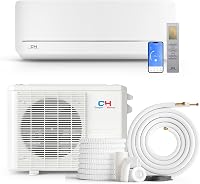
Cooper & Hunter 24000 BTU 230V
Best for app scheduling - 6
 Check it
Cooper & Hunter 24000 BTU Heat Pump
Best for colder winter conditions - 7
 Best for a finished basement bedroomCheck it
- 8
 Best for a DIY installation routeCheck it
- 9
 Check it
MRCOOL DIY Select 24000 BTU 230V
Best for quiet overnight operation
How we chose a mini split for basement use
A suitable basement mini split has capacity matched to the room and a heating range that fits local winters. We compared the stated capacities, control options, heating limits and installation requirements for each model.
We gave more weight to basement fit than to extra features alone. A system's stated room coverage is a starting point, not a guarantee for a particular basement.
| Product | Best for | Capacity | Controls | Heating limit | Our score |
|---|---|---|---|---|---|
| Senville LETO 12000 BTU | a compact finished basement | 12,000 BTU | Remote, app and Alexa | 5°F | 8.9 |
| Senville LETO 24000 BTU | an open basement | 24,000 BTU | App and remote | 5°F | 8.6 |
| Della Vario 24000 BTU | smart remote sensing | 24,000 BTU | WiFi and remote | -4°F | 8.2 |
| Pioneer Diamante Pro 18000 BTU 230V | a basement with a low ceiling | 18,000 BTU | -4°F | 8.0 | |
| Cooper & Hunter 24000 BTU 230V | app scheduling | 24,000 BTU | App and remote | 5°F | 7.9 |
| Cooper & Hunter 24000 BTU Heat Pump | colder winter conditions | 24,000 BTU | App and remote | -13°F | 7.7 |
| Della Serena 18000 BTU WiFi | a finished basement bedroom | 18,000 BTU | WiFi, app and remote | 5°F | 7.6 |
| MRCOOL Easy Pro 24000 BTU DIY | a DIY installation route | 24,000 BTU model | 7.4 | ||
| MRCOOL DIY Select 24000 BTU 230V | quiet overnight operation | 24,000 BTU | 7.0 |
The best mini splits for basements
These mini splits cover different room sizes and installation preferences, from a smaller finished room to a broad open basement. Match the capacity to a load estimate before buying.
Senville LETO 12000 BTU: Best for a compact finished basement
- 12,000 BTU
- Alexa and app control
- Heating works down to 5°F
- Professional installation required
A 12,000 BTU option for a smaller, defined basement area. App and Alexa control add ways to adjust the system, and Senville says it can heat down to 5°F.
Pros
- App and Alexa control
- Heating and cooling
- Installation kit includes a 16 ft line set
Cons
- Professional installation required
- Heating limit may not suit colder outdoor conditions
The Senville LETO 12000 BTU is a candidate for a compact finished basement or one defined section of a larger floor. It provides cooling, heating, dehumidifier and fan modes, with Alexa and app controls.
Senville says the heat pump can operate down to 5°F. If your area gets colder, consider a model with a lower stated heating limit or ask an HVAC contractor about your heating needs.
The package includes an indoor air handler, outdoor condenser, remote and installation kit with a 16 ft line set and communication wire. Senville requires professional installation.
Choose this model when a load calculation points to a smaller system and voice or app control is useful. Our guide to mini splits for small rooms covers other compact-space options.
Senville LETO 24000 BTU: Best for an open basement
- 24,000 BTU
- 18.7 SEER
- Alexa and app control
- Heating works down to 5°F
This higher-capacity LETO model is a candidate for a larger open basement. It includes app control and a 16 ft line set, with professional installation required.
Pros
- 24,000 BTU capacity
- App and Alexa control
- Heating and cooling
Cons
- Professional installation required
- Confirm the room load before choosing this capacity
The Senville LETO 24000 BTU is a strong option for a larger open basement with a load that supports its capacity. It offers cooling and heating, plus dehumidifier and fan modes.
App and Alexa control let you adjust settings remotely. Senville says the heat pump operates down to 5°F, and the system includes a 16 ft line set and communication wire.
Have an installer confirm the electrical supply, refrigerant line route and placement before ordering. Professional installation is required.
Pick it when the basement is open and the calculated load fits 24,000 BTU. For more options at this size, see our best 24,000 BTU mini splits.
Della Vario 24000 BTU: Best for smart remote sensing
- 24,000 BTU
- 21 SEER2
- Remote senses room temperature in cooling mode
- Heating works down to -4°F
The Vario combines 24,000 BTU capacity with a remote that senses room temperature during cooling. Della says professional installation is required.
Pros
- Remote room sensing in cooling mode
- Heating and cooling
- 16.4 ft installation kit
Cons
- Professional installation required
- WiFi supports 2.4 GHz only
The Della Vario 24000 BTU combines a larger capacity with remote sensing during cooling mode. In cooling mode, the remote senses room temperature and the unit adjusts airflow and temperature.
It offers 4D airflow, timer, sleep, eco, turbo and dry modes. The system is rated at 21 SEER2, and its heat pump operates down to -4°F.
The WiFi connection supports the 2.4 GHz band. Della requires professional installation.
Choose the Vario if its room sensing and control features suit your layout. The best 24,000 BTU mini splits guide compares more systems in this capacity range.
Pioneer Diamante Pro 18000 BTU 230V: Best for a basement with a low ceiling
- 18,000 BTU
- Recommended for 500 to 750 sq ft
- Mute mode
- Heating works down to -4°F
This 18,000 BTU system is recommended for 500 to 750 sq ft. Its indoor unit is 12.38 in high, a dimension to check when ceiling clearance is tight.
Pros
- Published recommended area
- Mute mode and washable filter
- Installation kit included
Cons
- 230V system
- Optional app control requires a separate module
The Pioneer Diamante Pro 18000 BTU 230V is recommended for spaces from 500 to 750 sq ft, making it a candidate for a medium finished basement when a load calculation agrees. Its indoor unit is 12.38 in high, so measure the wall and ceiling clearance before planning placement.
The remote includes I FEEL sensing, mute, eco, sleep and timer functions. The washable filter supports routine care, and the system has cooling, heating, dry and fan modes.
The system is specified to heat down to -4°F. Optional Pioneer AirLink app control requires a separately sold module, so this model suits remote control or someone willing to add that module.
Choose it for a defined basement area within the recommended range. See our best 18,000 BTU mini splits for other capacity-matched options.
Cooper & Hunter 24000 BTU 230V: Best for app scheduling
- 24,000 BTU
- 18.7 SEER2
- Smart Kit included
- Professional installation required
The MIA Series includes a Smart Kit for app scheduling and remote control. Its 24,000 BTU capacity calls for careful sizing in a basement.
Pros
- Smart Kit included
- Installation kit includes a 16 ft line set
- Heating and cooling
Cons
- Professional installation required
- 230V system
The Cooper & Hunter 24000 BTU 230V includes a Smart Kit for app scheduling and remote control. Its 24,000 BTU capacity calls for careful sizing in a basement.
The package includes a 16 ft insulated copper line set, communication cable and drainage extension. Cooper & Hunter requires professional installation, and the system is pre-charged.
The stated heating limit is 5°F, so check that against local winter conditions. Cooper & Hunter describes this model for large rooms, bonus spaces, offices and open layouts.
Pick it when app control and a larger capacity align with the basement plan. Our best mini split brands guide explains other factors to consider.
Cooper & Hunter 24000 BTU Heat Pump: Best for colder winter conditions
- 24,000 BTU
- Smart Kit included
- Heating works down to -13°F
- Professional installation required
This Cooper & Hunter heat pump is the cold-weather choice in this group, with heating operation stated down to -13°F. It needs professional installation.
Pros
- Lower stated heating limit than most picks here
- Smart Kit included
- Pre-charged system
Cons
- Professional installation required
- 230V system
The Cooper & Hunter 24000 BTU Heat Pump has a stated cold-weather heating limit of -13°F. Consider it when a basement needs heat through colder winter conditions and a load calculation supports its capacity.
It includes a Smart Kit and a pre-charged outdoor condenser. The 230V system also comes with a 16 ft insulated copper line set, communication cable and drainage extension.
Cooper & Hunter requires professional installation. Have the installer check whether 24,000 BTU fits the actual space and whether the outdoor unit can be placed appropriately.
Choose it when cold-weather heating matters and the calculated capacity is appropriate. For background on these systems, read how a mini split works.
Della Serena 18000 BTU WiFi: Best for a finished basement bedroom
- 18,000 BTU
- 22 SEER2
- WiFi and Alexa control
- Heating works down to 5°F
The Serena is an 18,000 BTU WiFi model with a stated room area of up to 1,000 sq ft. Its mute mode is rated at 22 dBa by Della.
Pros
- WiFi and Alexa control
- Reusable filters
- Heating and cooling
Cons
- Professional installation required
- WiFi supports 2.4 GHz only
The Della Serena 18000 BTU WiFi has stated coverage up to 1,000 sq ft, provided the room load supports that size. Its WiFi and Alexa controls let you adjust settings through an app or voice assistant.
Della gives a 22 SEER2 rating and states heating operation down to 5°F. The indoor unit has mute mode rated at 22 dBa, a reusable filter and heating, cooling, dry and auto modes.
This system requires professional installation. Its WiFi supports 2.4 GHz only.
Choose it when app control and an 18,000 BTU size fit the basement. For a broader capacity comparison, see our best 18,000 BTU mini splits.
MRCOOL Easy Pro 24000 BTU DIY: Best for a DIY installation route
- 24,000 BTU model
- 16 ft line set included
- Heating and cooling
- Stated coverage up to 1,200 sq ft
The Easy Pro is described as a DIY system and includes a 16 ft line set. Its stated coverage reaches up to 1,200 sq ft, but basement sizing still depends on the room.
Pros
- DIY installation described
- Heating and cooling
- 16 ft line set
Cons
- Coverage claim is not a substitute for a load calculation
- Confirm electrical and local installation requirements
The MRCOOL Easy Pro 24000 BTU DIY includes a 16 ft line set, and the system is described as a DIY mini split. Its stated coverage reaches up to 1,200 sq ft across capacity options, so confirm the specific model's fit for your basement.
The Easy Pro provides heating and cooling and includes a one-year labor warranty from IWAE. Its stated 24,000 BTU model is a substantial size for a basement, making a load calculation especially useful.
Check the installation instructions, electrical needs and local requirements before deciding on a DIY route. A basement with finished walls or limited outdoor access may also need extra planning for the line set and drainage.
Choose it if DIY installation is a priority and the room's load supports the capacity. Read our mini split installation cost guide for factors that affect project planning.
MRCOOL DIY Select 24000 BTU 230V: Best for quiet overnight operation
- 24,000 BTU
- Quick Connect line set
- Silent mode as low as 21.5 dB(A)
- Stated coverage up to 1,050 sq ft
The DIY Select uses a pre-charged Quick Connect line set and offers silent mode as low as 21.5 dB(A). MRCOOL states coverage up to 1,050 sq ft.
Pros
- Quick Connect line set
- App and voice controls
- Silent mode
Cons
- 230V system
- Confirm the coverage and installation requirements for your basement
The MRCOOL DIY Select 24000 BTU 230V pairs a 24,000 BTU heat pump with a pre-charged Quick Connect line set. It has stated coverage up to 1,050 sq ft and app and voice control.
Silent mode is rated as low as 21.5 dB(A), which may matter when the basement includes a bedroom or work area. The system is described for DIY installation, though you should check local electrical and HVAC requirements before starting.
Coverage figures do not account for every basement's insulation, ceiling height or room divisions. Confirm the load and installation route before choosing a 24,000 BTU system.
Pick this model if quiet operation and its Quick Connect setup suit your priorities. Our installation cost guide explains factors that can affect the project.
What should you check before choosing a basement mini split?
A basement mini split should match the heat loss and cooling load of the space, not just a rough square-foot range. Ask an HVAC professional to account for insulation, below-grade walls, windows, ceiling height and air leakage.
The layout matters too. One wall unit may work well in a broad open room, while closed bedrooms or divided areas can need separate zones or another way to move air.
Check where the indoor unit can go without blocking airflow. Also plan the outdoor unit location, drainage, electrical supply and refrigerant line route before buying equipment.
If you're unsure whether your basement needs one zone or more, our guide to multi-zone mini splits explains when separate indoor units can help.
Which mini split is the right choice for your basement?
Choose the Senville LETO 12000 BTU for a compact area if a load calculation supports its capacity. Choose the Senville LETO 24000 BTU for an open basement with a matching load, or the Cooper & Hunter 24000 BTU Heat Pump if colder winter heating is a key need.
For a DIY route, compare the MRCOOL Easy Pro and DIY Select instructions with local requirements before buying. Start with our mini split sizing chart and have the space assessed before settling on a model.
Our top 3 picks at a glance
-
1
-
2
-
3
Frequently asked questions
What size mini split do I need for a basement?
Choose capacity from a room-by-room load calculation that accounts for basement area, insulation, ceiling height, windows, air leakage and how much of the space is below grade. Square footage alone can miss these factors.
Our mini split sizing chart explains the starting points, but an HVAC professional can assess the actual room.
Can a mini split heat a basement in winter?
Yes, a heat pump mini split can heat a basement, but check its stated low-temperature heating limit against your local winter conditions. For example, the Cooper & Hunter Heat Pump here states heating operation down to -13°F, while other picks have higher limits.
A technician can help account for insulation and the basement's heat loss.
Is one mini split enough for a basement?
One indoor unit may suit an open basement with a clear path for air to move. Separate rooms, closed doors, corners or divided levels can leave distant areas less comfortable, so a single wall unit may not serve every space evenly.
Ask an HVAC professional whether one zone or a multi-zone setup fits your layout.
Can I install a basement mini split myself?
It depends on the system and local requirements. The MRCOOL DIY models here describe a DIY installation path, while Senville, Della and Cooper & Hunter call for professional installation.
Check the manufacturer's instructions and local electrical and HVAC rules before planning the work.
Where should a mini split go in a basement?
Place the indoor unit where its airflow can reach the main occupied area without being blocked by beams, shelves or partitions. The outdoor unit also needs an appropriate location and line-set route.
Have an installer check clearances, drainage, electrical access and condensate handling before choosing a mounting spot.