9 Best Multi Zone Mini Splits for 2 or 3 Rooms (November 2026)
The best multi zone mini split systems for 2 or 3 rooms include the Senville Dual Zone 28000 BTU for larger bedrooms, the Cooper & Hunter 2 Zone 18000 BTU for app-controlled zones, and the Senville 2 Zone 18000 BTU for home additions.
On this page (7 sections)
- Which best multi zone mini split fits your rooms?
- How should you choose sizes for a multi zone mini split?
- What should you plan before installation?
- What common multi zone mini split mistakes should you avoid?
- Are two zones enough for your rooms?
- How should you care for and use the system?
- Which multi zone mini split should you choose?
The best multi zone mini split for two rooms depends on the size and heating and cooling needs of each room. Matching handlers work when both spaces have similar loads; a 9K+12K combination can make more sense when one room needs less capacity.
These systems connect multiple indoor air handlers to one outdoor unit, so you can condition separate rooms without adding a separate condenser for each one. This roundup focuses on the listed two-zone configurations; if you need 3 rooms, check that the outdoor unit is designed for 3 handlers and supports the exact combination you want.
Start by estimating each room’s load, then confirm handler sizes, electrical requirements and line set routes with a qualified HVAC installer. Our ductless mini split buyer’s guide explains the system basics, and the mini split sizing chart can help you prepare for a room-by-room sizing discussion.
Our picks at a glance
-
1

-
2

-
3

Which best multi zone mini split fits your rooms?
The Senville Dual Zone 28000 BTU is the top pick here for two rooms that suit matching 12,000 BTU handlers. Choose based on your room loads and installation needs, then compare controls and included components.
| Product | Best for | Zones | Indoor unit sizes | Power | Our score |
|---|---|---|---|---|---|
| Senville Dual Zone 28000 BTU | larger bedrooms | 2 indoor air handlers | 12,000 BTU each | 208–230V | 7.8 |
| Cooper & Hunter 2 Zone 18000 BTU | app-controlled zones | 2 wall mount handlers | 12,000 BTU + 12,000 BTU | 208–230V | 7.5 |
| Senville 2 Zone 18000 BTU | home additions | 2 indoor air handlers | 7.4 | ||
| Costway Dual Zone 12K+12K | flexible airflow | 2 indoor units | 12,000 BTU + 12,000 BTU | 7.3 | |
| Rovsun Dual Zone 12K+12K | voice control | 2 indoor handlers | 12,000 BTU + 12,000 BTU | 208–230V | 7.3 |
| Rovsun Dual Zone 9K+12K | mixed-size rooms | 2 indoor handlers | 9,000 BTU + 12,000 BTU | 208–230V | 7.1 |
| Albott 2 Zone 12K+12K | cold-weather heating | 2 indoor units | 12,000 BTU + 12,000 BTU | 7.0 | |
| Costway Dual Zone 9K+12K | smart-home routines | 2 indoor units | 9,000 BTU + 12,000 BTU | 7.0 | |
| Albott 2 Zone 9K+9K | compact bedrooms | 2 indoor units | 9,000 BTU + 9,000 BTU | 6.6 |
Senville Dual Zone 28000 BTU: Best for larger bedrooms
- Two 12,000 BTU indoor handlers
- Independent room temperature adjustment
- App and supported voice assistant control
- Energy Star certified
Two 12,000 BTU indoor handlers and independent room controls suit buyers who want matching capacity in both zones. App and supported voice assistant control add remote adjustment.
Pros
- Independent temperature adjustment by room
- App and supported voice assistant compatibility
- Heat pump functionality
Cons
- Both indoor handlers are 12,000 BTU
- Requires 208–230V power
Senville’s Dual Zone 28000 BTU connects two 12,000 BTU indoor handlers to one 28,000 BTU outdoor condenser. Each room has independent temperature adjustment, and mobile apps and supported voice assistants allow remote operation and scheduling.
The system is Energy Star certified and has heat pump functionality for heating in low outdoor temperatures. It uses 208–230V power, so confirm that your home’s electrical setup can support it before planning installation.
This is a strong fit when both rooms can use similar capacity and you want remote controls. Skip it if one room needs a smaller handler or if your installer recommends a different capacity balance.
Cooper & Hunter 2 Zone 18000 BTU: Best for app-controlled zones
- 18,000 BTU system
- Two 12,000 BTU wall mount handlers
- Smart port adapters and app control
- Professional installation required
This Cooper & Hunter system pairs two 12,000 BTU handlers with app control through smart port adapters. It includes installation kits, and professional installation is required.
Pros
- App control for each handler
- Installation kit included for each handler
- Heating, cooling and inverter compressor
Cons
- Professional installation is required
- Uses 208–230V power
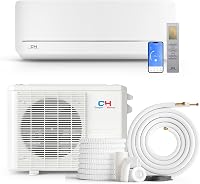
Cooper & Hunter’s 18,000 BTU system pairs two 12,000 BTU wall mount handlers with smart port adapters for app control of each unit. Each handler includes an installation kit with a 25 ft pre-flared, insulated copper line set, communication wires, small accessories and a 16 ft drainage extension.
The system uses 208–230V power and works for heating at outdoor temperatures as low as -13°F. Cooper & Hunter requires professional installation, and freight delivery is coordinated by the carrier.
Choose this option if matching handlers suit the room loads and individual app control is a priority. Skip it if you need different handler sizes or hope to install the equipment yourself.
Senville 2 Zone 18000 BTU: Best for home additions
- 18,000 BTU system
- Independent temperature controls
- App and voice control
- 16 ft line set and communication wire included
Senville offers an 18,000 BTU two-zone setup with independent room controls and app or voice operation. Its installation kit includes a 16 ft line set and communication wire.
Pros
- Independent temperature controls
- App and voice control
- Installation kit included
Cons
- Professional installation is required
- Confirm handler sizes for the exact configuration
Senville’s 18,000 BTU two-zone system includes indoor handlers, an outdoor condenser and an installation kit with a 16 ft line set and communication wire. It has independent room temperature controls and app or voice operation.
Senville describes the system for homes and commercial spaces, including bedrooms, additions, living rooms and stores. Professional installation is required, and you should confirm the handler sizes for the exact configuration you plan to buy.
Choose it if you want Senville’s app or voice controls and an installation kit. Skip it if you can’t confirm the handler combination or if the required professional installation does not fit your project.
Costway Dual Zone 12K+12K: Best for flexible airflow

- Two 12,000 BTU indoor units
- 23 SEER2
- Wi-Fi and Google Assistant
- 7 modes and 8 fan speeds
Costway's 12K+12K configuration combines room-by-room settings with 4D swing, Wi-Fi, Google Assistant and 7 operating modes. Professional licensed HVAC technician installation is recommended.
Pros
- 4D swing and 8 fan speeds
- Wi-Fi and Google Assistant control
- Washable filters and self-clean function
Cons
- Two 12,000 BTU handlers may not suit smaller rooms
- Professional installation is recommended
Costway’s 12K+12K configuration combines two 12,000 BTU indoor units with 4D swing, Wi-Fi, Google Assistant and a remote. It also has 7 modes, 8 fan speeds, washable filters and a self-clean function.
Costway states a 23 SEER2 rating and says the system can cool at outdoor temperatures up to 127°F and heat down to -4°F. Professional licensed HVAC technician installation is recommended.
Choose this configuration for two rooms with similar needs if you want several fan settings and smart controls. Skip it if either room calls for a smaller handler or if those modes and controls won’t be useful in your home.
Rovsun Dual Zone 12K+12K: Best for voice control

- Two 12,000 BTU indoor handlers
- 23 SEER2
- App, remote and voice control
- 25 ft line sets
Rovsun pairs two 12,000 BTU handlers with app, remote and voice control. The system includes 25 ft line sets, and professional licensed HVAC technician installation is recommended.
Pros
- Individual room controls
- App, remote and voice operation
- 25 ft line sets included
Cons
- Both handlers are 12,000 BTU
- Extra power cord is needed
Rovsun’s 12K+12K system gives each indoor handler its own controller and supports app, remote and voice control. It includes two 25 ft line sets, and Rovsun recommends professional licensed HVAC technician installation.
The system has heat pump, dehumidifier and fan modes, along with auto defrost, self-diagnosis, sleep mode and a 24-hour timer. Rovsun recommends keeping it upright for 24 hours before installation and scheduling installation after all 5 boxes arrive.
Choose this for two rooms that suit matching 12,000 BTU handlers and for app or voice access. Skip it if a room needs less capacity or if you cannot plan for the extra power cord.
Rovsun Dual Zone 9K+12K: Best for mixed-size rooms
- One 9,000 BTU and one 12,000 BTU handler
- 23 SEER
- App, remote and voice control
- 25 ft line sets
A 9K+12K combination gives the smaller room a lower-capacity handler than a matching 12K+12K setup. Each room has individual controls, while app, remote and voice operation offer several ways to adjust it.
Pros
- Different handler sizes for different room needs
- App, remote and voice control
- 25 ft line sets included
Cons
- Professional licensed HVAC technician installation is recommended
- Extra power cord is needed
The Rovsun 9K+12K setup has one 9,000 BTU handler and one 12,000 BTU handler. Each room has individual temperature control, and the system supports app, remote and voice operation.
It includes two 25 ft line sets and has heat pump, dehumidifier and fan modes, auto defrost and a 24-hour timer. Rovsun recommends professional licensed HVAC technician installation and says an extra power cord is needed.
Choose this when one room needs less capacity than the other and a room-by-room load calculation supports the combination. Skip it if both rooms need the same handler size or if the installer finds this outdoor and indoor combination unsuitable.
Albott 2 Zone 12K+12K: Best for cold-weather heating

- Two 12,000 BTU indoor units
- 25 SEER2
- App and remote control
- 30-minute self-cleaning function
Albott combines two 12,000 BTU handlers with app and remote control, plus a 30-minute self-cleaning function. Each indoor unit has separate temperature control.
Pros
- 25 SEER2
- Separate room temperature controls
- 30-minute self-cleaning function
Cons
- Both handlers are 12,000 BTU
- Confirm the electrical setup and breaker capacity before installation
Albott’s 12K+12K system pairs two 12,000 BTU handlers with app and remote control. Each indoor unit has separate temperature control, and the system has a 25 SEER2 rating, inverter technology and a 30-minute self-cleaning function.
Albott describes chassis heating and auto defrost, with stated operating limits of cooling at up to 131°F and heating down to -13°F. It recommends confirming the home’s electrical setup and breaker capacity before installation.
Choose it if both rooms suit matching 12,000 BTU handlers and you want app control and self-cleaning. Skip it if either room is smaller and better matched to a lower-capacity handler.
Costway Dual Zone 9K+12K: Best for smart-home routines
- One 9,000 BTU and one 12,000 BTU handler
- 23 SEER2
- Wi-Fi, Alexa and Google Assistant
- 7 operating modes
Costway's 9K+12K arrangement fits a plan where one zone needs a smaller handler than the other. It also offers Wi-Fi, Alexa and Google Assistant control.
Pros
- Different handler sizes for the two zones
- 7 modes and 8 fan speeds
- Washable filters and self-clean function
Cons
- Professional licensed HVAC technician installation is recommended
- Check room loads before choosing the handler sizes
Costway’s 9K+12K configuration pairs one 9,000 BTU handler with one 12,000 BTU handler. It offers Wi-Fi, Alexa and Google Assistant control, plus 7 modes, 8 fan speeds, washable filters and a self-clean function.
Costway states a 23 SEER2 rating and says the system can cool at outdoor temperatures up to 127°F and heat down to -4°F. Professional licensed HVAC technician installation is recommended.
Choose it when one room calls for a smaller handler and the other a larger one, with smart-home controls on both zones. Skip it if the room loads do not support those sizes or you prefer a simpler control setup.
Albott 2 Zone 9K+9K: Best for compact bedrooms
- Two 9,000 BTU indoor units
- 25 SEER2
- App and remote control
- 30-minute self-cleaning function
Two 9,000 BTU handlers suit buyers considering a lower-capacity setup for both zones. Albott provides separate temperature controls, app and remote operation, and a 30-minute self-cleaning function.
Pros
- Two matching 9,000 BTU handlers
- 25 SEER2
- Separate room temperature controls
Cons
- Lower combined capacity than the 12K+12K option
- Confirm sizing with a qualified installer
Albott’s 9K+9K setup puts a 9,000 BTU handler in each of two rooms. Each unit has separate temperature controls, app and remote operation, a 30-minute self-cleaning function, a 24-hour timer and sleep mode.
Albott gives an estimate of up to 400 sq ft for a 9,000 BTU unit. Treat that as a starting point, since insulation, windows, ceiling height and climate can change the load.
Choose this setup if both rooms have similar loads that suit 9,000 BTU handlers. Skip it if either room needs more capacity, and compare a 9K+12K arrangement after an installer sizes each space.
How should you choose sizes for a multi zone mini split?
Choose handler sizes from each room’s heating and cooling load, not the combined BTU label alone. A qualified HVAC installer can calculate each load using the room and building conditions.
A 9K+9K setup gives both rooms matching 9,000 BTU handlers. A 9K+12K pairing gives one room a larger handler, while a 12K+12K arrangement gives both rooms matching 12,000 BTU handlers.
Room size is only one part of sizing. Sun exposure, insulation, window area, air leakage, ceiling height and local weather can all affect how much heating or cooling a space needs.
Don’t add the handlers’ BTUs and assume the total is the amount each room will receive. The outdoor unit and the indoor units must be a supported combination, so have the installer verify compatibility for the exact model and configuration.
Our guides to 18,000 BTU mini split systems and 24,000 BTU mini split systems cover single-zone choices if your plan changes.
What should you plan before installation?
Plan the electrical supply, indoor unit locations, outdoor unit location and line set routes before ordering. These choices affect whether the equipment fits the building and what work the installer needs to do.
Several systems in this roundup use 208–230V power. Have an electrician or HVAC professional check the electrical setup and breaker capacity, and ask whether any added wiring or power cord is needed.
Pick indoor locations that allow air to move through each room without being blocked by furniture, curtains or room dividers. The outdoor unit also needs a suitable place, and the line sets and drainage paths need a clear route to it.
Ask the installer to confirm the line set lengths, wall openings, condensate drainage, mounting and service access. Some packages include line sets and installation materials, but that does not mean every part of your installation is covered.
Most systems here call for professional installation or recommend it. Get a quote before buying, and use our mini split installation cost guide to understand which project details can affect the total.
What common multi zone mini split mistakes should you avoid?
The most common mistakes are choosing by total BTU alone, assuming zones can run different modes, and ordering before checking power and line routes. Confirm each detail with the installer before you settle on a configuration.
Separate room temperature controls do not always mean one room can heat while another cools. Albott says its indoor units must use the same operating mode to avoid conflicts, so check the controls and operating instructions for the exact system.
Don’t assume a 9,000 or 12,000 BTU handler fits every room of a certain size. Coverage estimates are general starting points; ask for a load calculation before using them to make a final choice.
Don’t assume that accessories make a system a do-it-yourself project. Professional installation is required or recommended for these options, and refrigerant work and electrical connections need the right qualifications.
Forgetting delivery and setup details can delay an installation. Rovsun recommends keeping its system upright for 24 hours and scheduling installation after all 5 boxes arrive, so plan those steps with the installer.
Are two zones enough for your rooms?
Two zones are enough when you need separate conditioning for two rooms or areas. For 3 rooms, choose an outdoor unit designed for 3 handlers and confirm that it supports the exact handler combination.
A multi zone setup can be useful for rooms that have different schedules or comfort preferences, since each indoor handler has its own controls. It may not be the best fit when you only need to condition one room or when adding multiple line routes is impractical.
For more options by brand, see our guide to best mini split brands for home use. Our small-room mini split guide covers single-zone options for smaller spaces.
How should you care for and use the system?
Keep washable or mesh filters clean according to the manual, and use any self-cleaning feature as directed. These steps help keep routine care manageable, but they do not replace checks and service recommended by the manufacturer or installer.
Use the remote or app to set each room for the times you use it. Avoid frequent large setting changes, and keep the indoor unit’s air path clear so it can circulate air through the room.
Before the first heating or cooling season, ask the installer what routine checks apply to your system. For filter and indoor-unit care, see our guide to cleaning a mini split.
Which multi zone mini split should you choose?
Choose Senville’s 28,000 BTU two-zone system when both rooms suit 12,000 BTU handlers and app or voice control is a priority. Choose a 9K+12K system when the rooms have different loads, or Albott’s 9K+9K setup when both spaces suit smaller handlers.
Cooper & Hunter suits buyers who want app control for each handler and included installation kits. Costway offers more modes and fan speeds, while Rovsun combines app, remote and voice operation with 25 ft line sets.
Before you buy, have an installer confirm room loads, electrical needs, equipment compatibility and line set routes. Use the mini split sizing chart to prepare for that conversation.
Our top 3 picks at a glance
-
1
-
2
-
3
Frequently asked questions
What is a multi zone mini split?
A multi zone mini split connects multiple indoor air handlers to one outdoor unit. Each handler serves a separate room or area, and many systems let you set room temperatures independently.
Check the exact configuration before buying because a brand may offer several combinations of indoor unit sizes.
Is a 9K+12K system better than a 12K+12K system?
A 9K+12K system gives one room a smaller indoor handler and the other a larger one. That can fit rooms with different heating and cooling needs, but a room-by-room load calculation should guide the choice.
See our mini split sizing chart for the factors that affect capacity.
Can one multi zone system heat and cool different rooms at the same time?
Many multi zone systems let you adjust each room's temperature independently, but that does not mean the zones can run different operating modes at once. Albott says its indoor units must use the same mode to avoid conflicts.
Check the specific system's controls and operating instructions before planning mixed heating and cooling.
Does a multi zone mini split need professional installation?
Professional installation is recommended or required for the systems in this roundup. Refrigerant connections, electrical work and setup need a qualified HVAC technician, and some manufacturers specifically require professional installation.
Ask for an installation quote before choosing a system.
Our mini split installation cost guide explains what can affect the total.
How do you choose a multi zone mini split for 2 or 3 rooms?
Start with a load calculation for each room, then choose the number and size of indoor handlers to match those needs. Confirm the outdoor unit supports the planned combination, along with voltage, line set routing and installation requirements.
Our ductless mini split buyer's guide covers the system basics.