10 Best Mini Split Brands for Home Use (November 2026)
The best mini split brands for home use include the Senville LETO 24000 BTU for larger single zones, the Della Vario 12000 BTU Pre-Charged for feature-rich room control, and the Costway 12000 BTU for everyday heating and cooling.
On this page (4 sections)
The best mini split brands for home use offer different strengths, so choose based on your room size, power supply, controls and installation plan. Senville leads this group for a larger single zone, while Della and Costway offer distinct 12,000 BTU options.
There is no one brand that fits every home. A smaller bedroom, an open living area and a room addition can call for different capacities and installation choices.
Use this roundup to compare specific models, not to assume every product from a brand shares the same features. For basic system choices, read our ductless mini split buyer's guide and mini split sizing chart.
Our picks at a glance
-
1

-
2
 Best for feature-rich room control
Della Vario 12000 BTU Pre-Charged
8.4/10 our score
See it on Amazon -
3

- 4
 Best for a 115V connectionCheck it
- 5
 Check it
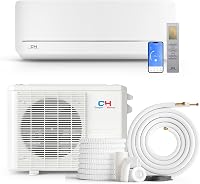
Cooper & Hunter MIA 12000 BTU 230V
Best for included smart controls - 6
 Check it
Pioneer Diamante Pro 12000 BTU 230V
Best for a defined room zone - 7
 Best for smaller rooms with app controlCheck it
- 8
 Best for remote-only simplicityCheck it
- 9
 Best for a DIY-focused 115V optionCheck it
- 10
 Best for app and voice featuresCheck it
Which mini split brands stand out for home use?
Senville, Della and Costway are strong starting points in this group, with other brands offering useful alternatives for 115V power, app controls or specific installation preferences. Compare the model details below and confirm room sizing with an HVAC professional.
Senville LETO 24000 BTU: Best for larger single zones
- 24,000 BTU cooling and heating
- App and Alexa control
- Heat pump operation down to 5°F
- Professional installation required
A higher-capacity single-zone choice with app control, heat pump operation and a 16 ft line set in the installation package. Match capacity to the room with an HVAC professional.
Pros
- 24,000 BTU cooling and heating
- App and Alexa control
- 5-year parts and compressor coverage
Cons
- Professional installation required
- Labor is not included in the warranty
Senville's LETO is the largest-capacity choice here, with 24,000 BTU of cooling and heating. It includes app control and Alexa support, plus a remote for direct adjustments.
The heat pump is specified to operate down to 5°F. Senville includes a 16 ft line set and communication wire, and says the system is pre-loaded with refrigerant for up to 25 ft.
Professional installation is required. Senville provides 5 years of parts and compressor coverage, but labor is not included.
Choose the LETO when your installer confirms that 24,000 BTU suits the zone. If your room is smaller, compare a lower-capacity option rather than relying only on a broad area estimate.
Della Vario 12000 BTU Pre-Charged: Best for feature-rich room control
- 12,000 BTU
- 23 SEER2
- Remote temperature sensing
- Professional installation required
The Vario combines a 12,000 BTU heat pump with several operating modes and a remote that senses room temperature. Its included installation kit is 16.4 ft long.
Pros
- Remote senses temperature near the controller
- 23 SEER2
- Multiple fan speeds and sleep mode
Cons
- Professional installation required
- Line set vacuuming is required
Della's Vario is a 12,000 BTU option with 23 SEER2 and a heat pump rated to work down to -4°F. It is intended for spaces up to 550 sq ft.
The remote senses temperature near the controller during cooling mode. That can make its reading more relevant to where you sit or sleep than a sensor at the indoor unit.
Della includes a 16.4 ft installation kit and requires professional installation. The line set must be vacuumed, and changes to its length require adjusting refrigerant levels.
This model fits buyers who want multiple controls and modes in a one-room system. Check the mini split installation cost guide before comparing installation needs.
Costway 12000 BTU: Best for everyday heating and cooling
- 12,000 BTU
- Five modes
- Inverter compressor
- Licensed HVAC installation required
Costway's 12,000 BTU system offers five modes, ECO and sleep settings, and a washable filter. Choose it if those everyday controls fit your room and installation plan.
Pros
- Five operating modes
- Washable filter and self-cleaning function
- 5-year parts and 8-year compressor coverage
Cons
- Licensed HVAC installation required
- Remote is the stated control method
Costway's 12,000 BTU system focuses on day-to-day modes: auto, cool, dry, heat and fan. The remote also offers ECO, sleep, iFEEL and turbo functions.
Its washable filter and self-cleaning feature support routine care, but they do not replace regular cleaning. Costway says the system should be installed by a licensed HVAC installer.
Costway covers parts replacement for 5 years and the compressor for 8 years. The warranty information provided here does not state labor coverage.
Choose it if you want five modes and a washable filter. Our Costway vs Senville comparison compares this 12,000 BTU model with a higher-capacity Senville option.
Albott 12000 BTU 115V: Best for a 115V connection
- 12,000 BTU
- 115V
- WiFi and remote control
- SEER2 18
Albott pairs a 12,000 BTU capacity with a stated 115V supply and built-in WiFi. Confirm electrical requirements and room sizing with a qualified installer.
Pros
- 115V model
- Built-in WiFi and remote control
- 5-year compressor and 7-year parts warranty
Cons
- Power cord is not included
- A vacuum must be pulled before use
Albott's model stands out for its stated 115V supply and built-in WiFi. It has 12,000 BTU capacity and a SEER2 18 rating.
Albott gives a coverage figure of up to 750 sq ft, but room shape, insulation and climate also matter. Ask an installer to confirm the capacity and electrical setup for your home.
Albott includes app and remote control, self-cleaning and removable filters. The power cord is not included, and the outdoor unit needs a vacuum pulled before use.
Pick Albott when 115V is a fit for your installation plan. Confirm the circuit and installation details before ordering.
Cooper & Hunter MIA 12000 BTU 230V: Best for included smart controls
- 12,000 BTU
- 21.3 SEER2
- Smart kit and remote included
- Professional installation required
The MIA includes a smart kit, remote and 16 ft insulated copper line set. Cooper & Hunter requires professional installation and registration after installation.
Pros
- Smart kit and remote included
- 21.3 SEER2
- Pre-charged outdoor condenser
Cons
- Professional installation required
- 230V supply
Cooper & Hunter's MIA is a 12,000 BTU, 230V system with 21.3 SEER2. Its package includes a smart kit, remote, pre-charged condenser and 16 ft insulated copper line set.
The system is designed for heating at outdoor temperatures down to 5°F. Cooper & Hunter requires professional installation and asks owners to register the system within 60 days of installation.
A smart kit gives you app-connected controls, while the remote handles everyday adjustments. Cooper & Hunter says U.S.-based technical support is available.
Choose MIA if the included smart kit and 230V setup fit your plans. If you're comparing it with MRCOOL, see our Senville vs MRCOOL brand comparison.
Pioneer Diamante Pro 12000 BTU 230V: Best for a defined room zone
- 12,000 BTU
- 20.0 SEER2
- Recommended for 350 to 500 sq ft
- Optional app module sold separately
Pioneer gives a recommended room range of 350 to 500 sq ft and includes a washable filter and installation kit. App control needs a separate module.
Pros
- Remote with I FEEL sensing
- Washable reusable filter
- Includes line set and installation accessories
Cons
- 230V supply
- App module sold separately
Pioneer's Diamante Pro pairs a 12,000 BTU capacity with a recommended room range of 350 to 500 sq ft. It uses 230V power and has a 20.0 SEER2 rating.
The remote includes I FEEL sensing, which detects temperature near the controller. Mute, sleep, eco and timer functions add options without requiring app control.
Pioneer says the system can heat down to -4°F and includes a washable filter and installation kit. App control requires a separately sold module.
This is a fit for buyers who want remote-based controls and a defined capacity range. Ask your installer to confirm the room match and electrical requirements.
Rovsun 9000 BTU WiFi: Best for smaller rooms with app control
- 9,000 BTU
- WiFi, app and voice control
- 115V
- Professional installation recommended
Rovsun's 9,000 BTU model adds app and voice control to a smaller-capacity system. It includes a 16.4 ft line set, and a power cord is needed separately.
Pros
- WiFi, app and voice control
- 115V model
- Mute mode listed at 28 dB
Cons
- Professional licensed installation recommended
- Power cord needed separately
Rovsun's 9,000 BTU model is the smallest capacity in this roundup. Rovsun gives a coverage figure of up to 400 sq ft and includes WiFi, app and voice controls.
The system runs on 115V and includes a 16.4 ft copper line and signal cord. A power cord is needed separately, and Rovsun recommends professional licensed installation.
The system has a 28 dB mute mode and heat pump operation. For a quiet bedroom, consider placement and airflow along with the stated sound level.
Choose it for a smaller room when an installer confirms capacity. For other room sizes, see our best mini splits for small rooms.
Mountman 24000 BTU: Best for remote-only simplicity
- 24,000 BTU
- 19 SEER2
- Four modes
- Remote control
Mountman offers 24,000 BTU capacity with four operating modes, a remote and a pre-charged condenser. Verify the right capacity for your room and the electrical requirements.
Pros
- 24,000 BTU capacity
- Four modes and four fan speeds
- Self-cleaning and automatic defrost
Cons
- 230V supply
- Remote control is the stated control method
Mountman offers another 24,000 BTU system, with a 230V supply and 19 SEER2 rating. Its four modes cover cooling, heating, drying and fan operation.
A remote controls the system, which may suit buyers who do not need app or voice features. Mountman also includes sleep and ECO modes, automatic defrost and a self-cleaning function.
Mountman gives a maximum coverage figure of 750 sq ft in its product information. Confirm capacity and room coverage with an HVAC professional.
Choose Mountman if 24,000 BTU and remote controls fit your needs. Confirm electrical requirements before deciding.
MRCOOL Easy Pro 12000 BTU: Best for a DIY-focused 115V option
- 12,000 BTU
- 115V
- Voice control
- Manufacturer describes installation as DIY
MRCOOL presents Easy Pro as a DIY installation option and includes system lines. Check the instructions and local requirements before deciding whether you can install it yourself.
Pros
- 115V model
- Voice control with Alexa and Google Assistant
- Washable filters
Cons
- 12,000 BTU capacity may not fit every room
- Confirm local installation and electrical requirements
MRCOOL's Easy Pro is a 12,000 BTU, 115V system for spaces up to 550 sq ft. MRCOOL describes installation as DIY and says the package includes the system and lineset.
Alexa and Google Assistant support provide voice control, and the filters are washable. Follow the installation instructions and local requirements.
Choose Easy Pro if a DIY approach matters and the model's requirements fit your home. Our Senville vs MRCOOL comparison covers the brand choice in more detail.
YITAHOME 12000 BTU 220V: Best for app and voice features
- 12,000 BTU
- WiFi, app and voice control
- Five operating modes
- Licensed HVAC professional required
YITAHOME offers app and voice control, five modes and a washable filter. The stated 220V supply and professional installation requirement are key checks before choosing it.
Pros
- WiFi, app and voice control
- Five operating modes
- Includes installation kit
Cons
- Licensed HVAC professional required
- Two cartons may arrive separately
YITAHOME's 12,000 BTU model includes WiFi, app and voice control, with five operating modes. The manufacturer says installation must be done by a licensed HVAC professional.
YITAHOME's product title says 220V, while a bullet and model details identify a 115V version. Verify the supply voltage for the exact model with YITAHOME or your installer before buying.
The washable filter, automatic defrost and self-cleaning features support routine upkeep. The installation kit is included, though the outdoor wall mounting bracket, shut-off valves cover and side protection grille are not.
YITAHOME gives coverage up to 750 sq ft, but the room still needs a capacity assessment. The manufacturer says packages may arrive in two cartons, so confirm that both have arrived before installation.
Choose it if app or voice controls matter and the verified voltage fits your electrical plan. Ask your installer to confirm capacity and package contents before scheduling work.
How should you compare mini split brands?
Compare capacity, voltage, controls, installation requirements and warranty terms before choosing a brand. The specific model needs to fit your space and project.
Start with capacity and room conditions. The mini split sizing chart can help you prepare questions, while an HVAC professional can account for insulation, windows, layout and local climate.
Next, check electrical supply and installation requirements. Several models here call for professional installation, and voltage varies across the lineup.
Read the model requirements before assuming it will fit your existing circuit.
Finally, compare how you want to control the system. Some models include app or voice options, while others rely on a remote.
Warranty coverage may treat parts, compressor and labor differently.
What should you know before buying a mini split?
Plan for system sizing, electrical work, line set routing, condensate drainage and installation before choosing a mini split brand. A system purchase involves more than picking a brand and BTU number.
Ask the installer whether the included line set length suits the layout. Changes to line set length can affect refrigerant needs, and each model's installation instructions should guide the work.
Think about maintenance before choosing convenience features. Washable filters still need regular cleaning, and indoor and outdoor units need clear access for inspection and service.
Which mini split brand should you choose?
Choose Senville for a larger single-zone option with app control, Della for remote sensing and multiple operating modes, or Costway for its five modes and washable filter. For 115V choices, compare Albott, Rovsun and MRCOOL, then confirm capacity and installation needs with a qualified HVAC professional.
Use our Costway 12000 BTU review for a closer look at that model. If you're shopping for a different capacity, compare the best 18,000 BTU mini splits before settling on a brand.
Our top 3 picks at a glance
-
1
-
2
Best for feature-rich room control
Della Vario 12000 BTU Pre-Charged
8.4/10 our score
See it on Amazon -
3
Frequently asked questions
Which mini split brand is best for home use?
The best fit depends on your room, electrical supply, installation plan and preferred controls. Senville offers a 24,000 BTU system with app and Alexa control, while Della and Costway offer 12,000 BTU options with different operating features.
Match capacity to the space with an HVAC professional before choosing a brand.
Are mini split brands interchangeable?
No. Brands and models can differ in capacity, voltage, controls, included installation parts and installation requirements.
Check the model details and ask your installer to confirm electrical needs, line set compatibility and the work required before buying.
Do mini splits need professional installation?
Many systems in this guide call for professional installation, including models from Senville, Della, Costway and Cooper & Hunter. MRCOOL describes its Easy Pro as a DIY option.
Follow the model instructions and local rules, and ask a qualified HVAC professional if you are unsure.
How do I choose the right mini split size?
Start with the room's area, layout, insulation and climate, then ask an HVAC professional to size the system. A brand's stated coverage range is a starting point, not a substitute for a room assessment.
See our mini split sizing chart for a first look at capacity.
What should I compare between mini split brands?
Compare capacity, voltage, control options, heating range, installation requirements, included line set and warranty terms. These details vary across brands, even when two units share the same BTU rating.
Our Senville vs MRCOOL comparison looks more closely at two brands.